

Writing a final will might feel intimidating or stressful, especially if you are not sure where to start. Oftentimes, our clients wonder about their options, how the process works, and what happens to their loved ones once they pass on.
This article addresses a wide variety of common questions we regularly receive in our notarial practice. This includes information to help you understand the different types of wills and their associated risks, what happens if you have minor children, a common law spouse and more. We also address the risks of dying without a will.
Types of wills in Québec
There are three different types of wills in Québec, and each is governed by distinct legal rules. While it is possible to write a will without a notary, doing so carries greater risks, including delays, additional costs, or court involvement after death. Therefore, understanding all of your alternatives is vital for making informed choices and preserving your wishes and instructions.
“While it is possible to write a will without a notary, doing so carries greater risks, including delays, additional costs, or court involvement after death.”
Holographic will
A holographic will is a type of non-notarial will. It is written entirely by the person making the will, referred to as the testator.
A holographic will must meet specific legal requirements to be considered valid. Its main characteristics include:
- Handwritten by the testator (cannot be typed)
- Signed and dated by the testator
- Requires court verification after death (~$3,000)
- Not registered
- Contestable
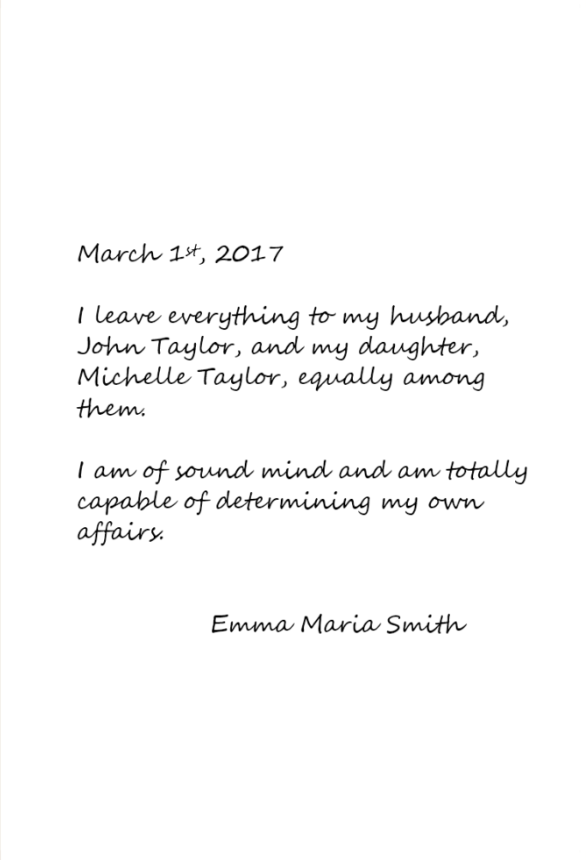
To learn more about this type of will and its disadvantages, explore the Holographic Will Template.
Will before witnesses
A will before witnesses is another type of non-notarial will. It must meet specific legal requirements to be considered valid and reliable after death.
The main characteristics of a will before witnesses include:
- Written or printed by the testator or a third person
- Signed by the testator in the presence of two witnesses of full age
- Signed by the two witnesses
- May be prepared and signed by a lawyer and registered with the Québec Bar
- Requires court verification after death (~$3,000)
- Contestable

Interested in learning more? Access the Witness Will Template for a detailed overview.
Notarial will
A notarial will is considered the most secure form of last will and testament in Québec. Why? Because it is prepared, executed, and preserved under strict legal and professional standards.
A notarial will must be written by a notary in a specific legal form, printed on prescribed paper, and signed in their presence. Subsequently, the notary will register the will and enter it into a notarial vault.
The main characteristics of a notarial will include:
- Written by a notary
- Signed before a notary and one witness
- Does not require court verification after death
- Conservation in the notary’s fireproof or electronic vault
- Registered at the Chambre des notaires du Québec.
- Modifications may be made easily through an annex (Codicil)
- Not contestable
- Most secure legal document for estate planning in Québec

Want to learn more about this option? Visit the notarial will and testament page or explore the Why Write a Will resource.
I want to write my own will. Are there risks?
Writing your last will on your own may seem simpler at first. However, doing so comes with specific risks and disadvantages that are important to be aware of.
Before addressing what these are, it is worth revisiting an important point mentioned earlier. Any will that is not executed before a notary is considered, in all cases, a non-notarial will. This includes a will prepared by a lawyer, a will signed before witnesses, and a handwritten (holographic) will.
If your will falls into one of these categories, it must be probated by the courts of Québec before it can be used for the liquidation of the estate. Probate is mandatory, as the court must first verify the validity of the will. This step is required because, when a will is prepared without a notary, there is no legal professional to confirm your identity or attest that the will was made freely and willingly. Read more about the will probate process.
In addition, for both holographic wills and wills made before witnesses, your heirs will be required to apply for probate themselves. This legal procedure can be lengthy, often taking three months or more, and it can be costly, sometimes exceeding $3,000. There is also an added risk with non-registered wills: they might get lost, accidentally destroyed, or intentionally discarded by someone who disagrees with their contents.
Who can write a will in Québec?
Anyone can write a last will before a notary. However, the testator must be in a healthy mental state at the time that the will is written. If the testator is ill or hospitalized, a medical note from a licensed physician will be required before the last will is drafted to confirm capacity.
When is a good time to write my will?
The best time to write a will is when you are well and able to make clear, informed decisions.
That said, it becomes particularly important not to wait should any of the following apply:
- If you have a spouse or children
- If you have a common-law spouse
- If you own property in Québec, such as a house, bank accounts, or savings
- If you plan to travel outside of Québec or be absent, either temporarily or permanently
- If you are ill or unwell
Writing a will ahead of time helps ensure that your wishes are clearly documented and can be carried out when needed.
Can I write my will online?
Yes, absolutely, should the circumstances require it, a notarial will can be signed remotely.
The testator signs the will using an electronic signature on the official Quebec Notarial signing platform, and the notary signs using a secure, numerically encrypted algorithmic signature. Once signed, the notary issues official electronic copies of the document bearing an electronic notarial seal. This process reflects current notarial practices in Québec.
Dying without a will in Québec
When a person dies without a will, the default provincial devolution laws will apply. In such circumstances, the law determines how the deceased’s property will be distributed and to whom. It also requires the heirs to act as liquidators of the estate.
In such cases, the heirs must work with a notary to prepare a declaration of heredity, as well as a nomination or renunciation of liquidator. Through these formal documents, the notary refers to the legal provisions prescribed by law so that the estate liquidation process can proceed.
Important note: Dying without a will is often more expensive. A notary will be required to prepare additional documents at the time of death, including a Declaration of heredity and a nomination of liquidator, which creates more expenses for the estate.
Protecting minor children through your will
Under Québec law, a minor is any person under the age of 18. The only way to protect minor children in the event of a parent’s death is through a notarial will.
When it comes to inheritance, it is important to note that, under Québec law, minor children cannot hold more than $40,000 in their own name without notifying the Québec Curator and appointing a tutor responsible for administering the minor’s property. Furthermore, minor children cannot inherit residential or commercial real estate that is subject to a mortgage guaranteed by a lien.
Consequently, when drafting your will, we can discuss the possibility of establishing a simple trust or an administration of property for your child, which they will be able to access once they turn 18.
With respect to guardianship, if both biological parents have passed away or are otherwise incapable, the nomination of a tutor with guardianship for the minor will be necessary. The tutor will be vested with parental authority and will be responsible for the care of the minor.
It is possible to nominate a tutor for your minor children through a notarial will.
What about common-law partners?
In Québec, the legal rules that apply to common-law partners are often misunderstood. Many people assume that living together for a certain number of years creates the same inheritance rights as marriage, but this is not the case.
Common-law partners do not inherit from each other unless it is explicitly stated in a will. Without a will, the surviving partner has no automatic right to inherit from the deceased’s estate.
In order to avoid legal litigation and properly secure and protect the rights of your common-law spouse, writing a notarial will is strongly recommended.
What about spouses under a parental union?
In Québec, the parental union regime gives certain protections to de facto partners who are the parents of the same child, particularly through the creation of a parental union patrimony.
However, this regime should not be confused with marriage or civil union, and it does not automatically make the surviving partner an heir. A parental union partner does not inherit from the deceased partner’s estate unless this is expressly provided for in a will. That said, the surviving partner may still be entitled to make claims relating to the partition of the parental union patrimony, which may include certain property accumulated or used during the parental union.
To avoid uncertainty, prevent disputes, and properly protect the surviving partner and the children, preparing a notarial will is strongly recommended.
Peace of mind with the right legal approach
Writing your last will while you are well allows you to make informed decisions and carefully protect your assets. Beyond ensuring that your wishes are respected, a properly drafted document provides reassurance and a sense of security for the people you leave behind.
The team at Chalati Notary & Lawyer have extensive experience in will preparation and estate planning, supporting clients at every stage of the process. If you are ready to move forward, we are available to assist you. Contact us today and schedule your free consultation.